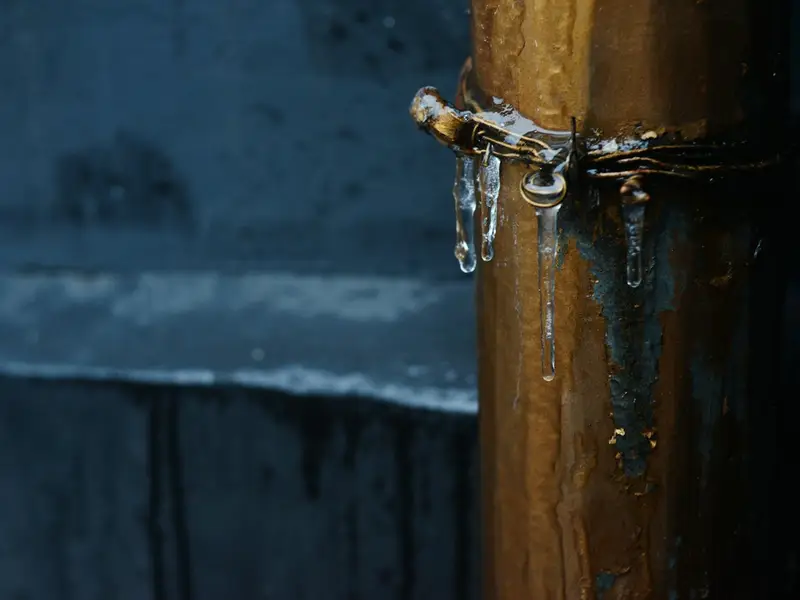
Most frozen pipe calls in Englewood come the morning after a hard cold snap, or a day later when temperatures climb and the ice in the pipe melts. While the pipe is frozen solid, the crack stays plugged. Once it thaws, water pushes out of the split at full house pressure, often inside a wall or under a sink where nobody sees it right away.
If that's where you are, the first job is simple: shut off the main water valve. Then call us, and we'll take the frozen pipe burst cleanup from there.
Signs a frozen pipe has burst
No water, then a hiss
A faucet gave nothing during the freeze, and now you hear running water with everything turned off.
Wet spots on outside walls
Damp drywall or bubbling paint low on an exterior wall, or near a hose bib or kitchen sink.
Water in the basement or garage
Pipes in unheated spaces split first. Look for puddles near the water heater, the main shut-off or the laundry.
A drip from the ceiling
A split line in an attic, bathroom or outside wall upstairs often shows up as a ceiling stain or drip below.
Why pipes freeze in Englewood homes
Englewood gets real Front Range winters: sunny, mild days followed by single-digit nights, and the odd arctic blast that sits for days. The pipes that freeze are almost always the same ones:
- Supply lines that run through exterior walls, especially behind kitchen and bathroom sinks
- Pipes in crawl spaces, garages and unfinished basement corners
- Outdoor hose bibs that were left connected to a hose
- Homes where the heat was turned way down while the family was away
What we do when a frozen pipe bursts
1. Make it safe
We confirm the water is off, check for wet outlets and cords, and tell you which areas to keep out of. If the pipe hasn't been repaired yet, we'll tell you so you can get a plumber lined up while we start on the water.
2. Get the water out
We extract standing water from carpet, tile and concrete, and pull up soaked carpet pad when it can't be saved. Furniture gets lifted onto blocks so the legs don't wick water and stain the floor.
3. Find where it went
Frozen pipes usually sit inside a wall or ceiling, so the hidden water is the real problem. We use moisture meters and thermal checks to map the wet area in walls, subfloor and the room below, and we only open drywall where the readings say we have to. More on that on our burst pipe in a wall page.
4. Dry it the right way
Commercial dehumidifiers and air movers run around the clock, and we take readings every day. Most rooms are dry in three to five days. See how extraction and drying work.
Frozen pipe damage and your insurance
Water damage from a pipe that suddenly freezes and bursts is usually covered by a standard Colorado homeowners policy. What insurers look closely at is whether the home was kept heated. Take photos of the leak, the thermostat setting and the wet areas before anything is moved. We add our own moisture readings and photos to your file so the adjuster sees the full picture.
How to keep it from happening again
- Keep the heat at 55°F or higher, even when you're away
- Open sink cabinet doors on outside walls during cold nights
- Let a faucet on an outside wall drip slowly when it drops into the single digits
- Disconnect hoses and close the inside valve to outdoor spigots in the fall
- Add foam insulation to pipes in the garage, crawl space and basement
Frozen pipe burst cleanup across Englewood
Cold snaps hit the whole area at once, so frozen pipe calls come from every corner of Englewood: the older streets around downtown and the Hampden corridor, the neighborhoods west toward Sheridan, and the newer homes up by Cherry Hills Village and Greenwood Village. We cover all four Englewood ZIP codes, 80110, 80111, 80112 and 80113.
If you're dealing with frozen pipe water damage in Englewood right now, keep the main valve off, keep the heat on, and call. The faster the drying starts, the less of your home has to be opened up.
Areas we cover: Englewood 80110, Englewood 80111, Englewood 80112, Englewood 80113, plus Downtown Englewood, Cushing Park, Belleview Park and Arapahoe Acres.
Frozen pipe questions
Will a frozen pipe always burst?
No. Many frozen pipes thaw without damage. The risk is highest when ice forms between a closed faucet and the freeze point, which builds pressure until the pipe splits.
Why didn't my pipe leak until it thawed?
Ice plugs the crack while it's frozen. When it melts, water comes out at full pressure. That's why so many frozen pipe leaks are found the day after a cold snap.
How long does frozen pipe water damage take to dry?
Most rooms take about three to five days with commercial drying equipment. Wall cavities and hardwood can take a little longer, which is why we check readings daily.
Can I just use fans and a shop vac?
For a small puddle on tile, maybe. When water has run inside a wall or under flooring, fans only dry the surface and the hidden moisture stays behind. That's how mold and warped floors start.