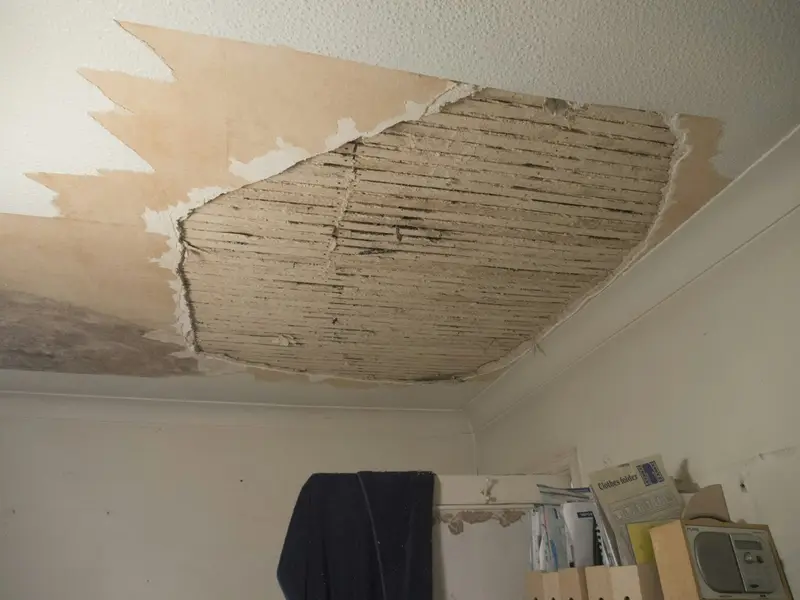
Ceiling damage is usually the first sign of a burst pipe you can't see: a bathroom supply line upstairs, a pipe in a cold attic or an outside wall. Water spreads across the top of the drywall, soaks it, and then shows up as a stain, a bubble or a steady drip. The ceiling is just where it finally comes through.
If water is coming through the ceiling right now
- Shut off the main water valve
- Put a bucket under the drip and move furniture and rugs out of the way
- If there's a bulge, don't push on it. Call us. A small, controlled hole lets the water drain out into a bucket instead of the whole panel coming down
- Take photos of the ceiling and the room above it
Signs of a ceiling leak from a burst pipe
Brown or yellow rings
A stain that grows or darkens means water is still getting in, not just an old mark.
Bubbling or peeling paint
Water sitting behind the paint layer pushes it out into blisters.
Sagging drywall
A soft, dropped section means water is pooled on top. This one needs attention fast.
Dripping fixtures
Water finds the holes for lights and fans first. Turn that circuit off.
How we handle ceiling water damage
Find the real source
The wet spot on the ceiling isn't always under the leak. Water runs along joists before it drips. We check the floor above, the walls and the attic with moisture meters so the whole wet area gets dried, not just the stain.
Open only what's needed
If the drywall is still solid, we can often dry it in place with small vent holes. If it's soft, sagging or stained through, we remove just that section so the joists and insulation above can dry.
Dry the ceiling and the floor above
A ceiling leak usually means the subfloor and maybe the flooring upstairs got wet too. We dry both together. See how drying works.
Insulation
Wet blown-in or batt insulation in an attic or between floors rarely dries well. It's usually removed and replaced after the framing is dry.
Why ceiling leaks lead to mold
The space above a ceiling is dark and closed in. If it stays wet for more than a day or two, mold can start on the back of the drywall where you won't see it until it's already spread. Drying the cavity, not just the paint surface, is what prevents it.
Ceiling leak help across Englewood
Ceiling leaks from burst pipes show up in all kinds of Englewood homes: two-story houses with upstairs bathrooms, ranches with pipes in a cold attic, and townhomes where a neighbor's line lets go. We cover every Englewood ZIP code, 80110 to 80113, and the surrounding south Denver suburbs.
If your Englewood ceiling is stained, bulging or dripping after a burst pipe, keep the room clear, turn off the water and the light circuit, and call. A ceiling caught early is often dried and repainted instead of replaced.
Areas we cover: Englewood 80110, Englewood 80111, Englewood 80112, Englewood 80113, plus Downtown Englewood, Cushing Park, Belleview Park and Arapahoe Acres.
Ceiling leak questions
Can a water-stained ceiling be dried instead of replaced?
Often yes, if the drywall is still firm and the water was clean. We dry it in place, then it can be primed with a stain-blocking primer and painted. Soft or sagging sections are replaced.
Is a sagging ceiling dangerous?
Yes. Wet drywall is heavy and can fall without warning. Keep people and pets out of that room and call so it can be drained in a controlled way.
Why is water coming through my ceiling when nothing upstairs is leaking?
The pipe that burst may be inside a wall, under the floor or in the attic. Water also travels along joists, so the drip can be several feet from the actual leak.
How long does a ceiling take to dry?
Usually two to four days once the cavity is opened or vented and dehumidifiers are running. We confirm it with readings before closing anything up.